Quick tips:
Remember to use clean towels and wash your pillowcase and sheets regularly.
If you must use hair products, keep your hair out of your face, as the product could irritate skin and cause breakouts.
When choosing cosmetics or any other type of face product, test behind the ear for at least one week to see if it is tolerated.
Use medicated, oil-free cosmetics. Concealers are available in many shades that will cover up the pimples and treat them at the same time.
Do not wash your face excessively.
Make sure to cleanse your face after rigorous exercise.
Use scrubs cautiously, as they may irritate skin.
Do not manipulate pimples with your fingers (squeezing or picking) or touch your face excessively, as they heal better and faster without touching.
Thursday, March 29, 2007

Tuesday, March 27, 2007
Research Being Done on Acne
Medical researchers are working on new drugs to treat acne, particularly topical antibiotics to replace some of those in current use. As with many other types of bacterial infections, doctors are finding that, over time, the bacteria that are associated with acne are becoming resistant to treatment with certain antibiotics, though it is not clear how significant a problem this resistance represents.
Scientists are also trying to better understand the mechanisms involved in acne so that they can develop new treatments that work on those mechanisms. For example, one group of NIAMS-supported researchers is studying the mechanisms that regulate sebum production in order to identify ways to effectively reduce its production without the side effects of current medicines. Another group is trying to understand how P. acnes activates the immune system in order to identify possible immunologic interventions. Other areas of research involve examining the effects of isotretinoin on an area of the brain that might lead to depression and developing a laser system to treat acne and acne-related scars without damaging the outer layers of the skin.
Researchers in Germany, funded by German institutions, have taken P. acnes and identified its genetic information (genome). This information may help researchers develop new treatments to target the bacteria.
Scientists are also trying to better understand the mechanisms involved in acne so that they can develop new treatments that work on those mechanisms. For example, one group of NIAMS-supported researchers is studying the mechanisms that regulate sebum production in order to identify ways to effectively reduce its production without the side effects of current medicines. Another group is trying to understand how P. acnes activates the immune system in order to identify possible immunologic interventions. Other areas of research involve examining the effects of isotretinoin on an area of the brain that might lead to depression and developing a laser system to treat acne and acne-related scars without damaging the outer layers of the skin.
Researchers in Germany, funded by German institutions, have taken P. acnes and identified its genetic information (genome). This information may help researchers develop new treatments to target the bacteria.
Monday, March 26, 2007
Common Problems of Aging Skin
As we age, the body undergoes many natural changes associated with aging skin. Genes determine the natural aging process (intrinsic aging), which cannot be altered, but there is a lot we can do to minimize the effects of premature skin aging (extrinsic aging) caused by our environment and lifestyle.
Intrinsic aging is characterized by decreased production of collagen and elastin (which give skin its strength and elasticity), decreased skin cell turnover (shedding of dead cells), and loss of fat beneath skin. These changes manifest as fine wrinkles, thin skin, hollowed cheeks and eye sockets, and sagging dry skin that may itch. These changes usually begin in our 20s, but they do not become noticeable until much later in life. There is little we can do to alter this process.
Extrinsic aging, on the other hand, is usually caused by the effects of the sun. It is also known as photoaging. These changes resemble the natural aging of skin, only that they appear much earlier in life. The damage caused by the sun is cumulative, meaning that your skin never forgets your tans and burns - even from your childhood! Your degree of premature skin aging thus depends on the total amount of sun you've received over the years. Smoking can also age skin by producing oxygen free radicals that cause premature wrinkles.
Intrinsic aging is characterized by decreased production of collagen and elastin (which give skin its strength and elasticity), decreased skin cell turnover (shedding of dead cells), and loss of fat beneath skin. These changes manifest as fine wrinkles, thin skin, hollowed cheeks and eye sockets, and sagging dry skin that may itch. These changes usually begin in our 20s, but they do not become noticeable until much later in life. There is little we can do to alter this process.
Extrinsic aging, on the other hand, is usually caused by the effects of the sun. It is also known as photoaging. These changes resemble the natural aging of skin, only that they appear much earlier in life. The damage caused by the sun is cumulative, meaning that your skin never forgets your tans and burns - even from your childhood! Your degree of premature skin aging thus depends on the total amount of sun you've received over the years. Smoking can also age skin by producing oxygen free radicals that cause premature wrinkles.
Saturday, March 24, 2007
More Info on Acne
Where Can People Find More Information on Acne?
National Institute of Arthritis and Musculoskeletal and Skin Diseases (NIAMS)
National Institutes of Health
1 AMS Circle
Bethesda, MD 20892-3675
Phone: 301-495-4484 or 877-22-NIAMS (226-4267) (free of charge)
TTY: 301-565-2966
Fax: 301-718-6366
E-mail: NIAMSInfo@mail.nih.gov
www.niams.nih.gov
NIAMS provides information about various forms of arthritis and rheumatic disease and bone, muscle, joint, and skin diseases. It distributes patient and professional education materials and refers people to other sources of information. Additional information and updates can also be found on the NIAMS Web site.
American Academy of Dermatology
P.O. Box 4014
Schaumburg, IL 60168-4014
Phone: 847-330-0230 or 888-462-3376 (free of charge)
Fax: 847-330-0050
www.aad.org
This national organization can provide referrals to dermatologists. It also publishes a brochure on acne for adults and a fact sheet for young people. These are available on the organization's Web site or can be obtained by calling or writing to the academy.
National Institute of Arthritis and Musculoskeletal and Skin Diseases (NIAMS)
National Institutes of Health
1 AMS Circle
Bethesda, MD 20892-3675
Phone: 301-495-4484 or 877-22-NIAMS (226-4267) (free of charge)
TTY: 301-565-2966
Fax: 301-718-6366
E-mail: NIAMSInfo@mail.nih.gov
www.niams.nih.gov
NIAMS provides information about various forms of arthritis and rheumatic disease and bone, muscle, joint, and skin diseases. It distributes patient and professional education materials and refers people to other sources of information. Additional information and updates can also be found on the NIAMS Web site.
American Academy of Dermatology
P.O. Box 4014
Schaumburg, IL 60168-4014
Phone: 847-330-0230 or 888-462-3376 (free of charge)
Fax: 847-330-0050
www.aad.org
This national organization can provide referrals to dermatologists. It also publishes a brochure on acne for adults and a fact sheet for young people. These are available on the organization's Web site or can be obtained by calling or writing to the academy.
Friday, March 23, 2007
Great Tips to Keep in Mind!!
Avoid Frequent Handling of the Skin
Avoid rubbing and touching skin lesions. Squeezing, pinching or picking blemishes can lead to the development of scars or dark blotches.
Shave Carefully
Men who shave and who have acne should test both electric and safety razors to see which is more comfortable. When using a safety razor, make sure the blade is sharp and soften your beard thoroughly with soap and water before applying shaving cream. Shave gently and only when necessary to reduce the risk of nicking blemishes.
Avoid a Sunburn or Suntan
Many of the medicines used to treat acne can make you more prone to sunburn. A sunburn that reddens the skin or suntan that darkens the skin may make blemishes less visible and make the skin feel drier. However, these benefits are only temporary, and there are known risks of excessive sun exposure, such as more rapid skin aging and a risk of developing skin cancer.
Choose Cosmetics Carefully
While undergoing acne treatment, you may need to change some of the cosmetics you use. All cosmetics, such as foundation, blush, eye shadow, moisturizers, and hair-care products should be oil free. Choose products labeled noncomedogenic (meaning they don't promote the formation of closed pores). In some people, however, even these products may make acne worse.
For the first few weeks of treatment, applying foundation evenly may be difficult because the skin may be red or scaly, particularly with the use of topical tretinoin or benzoyl peroxide.
Avoid rubbing and touching skin lesions. Squeezing, pinching or picking blemishes can lead to the development of scars or dark blotches.
Shave Carefully
Men who shave and who have acne should test both electric and safety razors to see which is more comfortable. When using a safety razor, make sure the blade is sharp and soften your beard thoroughly with soap and water before applying shaving cream. Shave gently and only when necessary to reduce the risk of nicking blemishes.
Avoid a Sunburn or Suntan
Many of the medicines used to treat acne can make you more prone to sunburn. A sunburn that reddens the skin or suntan that darkens the skin may make blemishes less visible and make the skin feel drier. However, these benefits are only temporary, and there are known risks of excessive sun exposure, such as more rapid skin aging and a risk of developing skin cancer.
Choose Cosmetics Carefully
While undergoing acne treatment, you may need to change some of the cosmetics you use. All cosmetics, such as foundation, blush, eye shadow, moisturizers, and hair-care products should be oil free. Choose products labeled noncomedogenic (meaning they don't promote the formation of closed pores). In some people, however, even these products may make acne worse.
For the first few weeks of treatment, applying foundation evenly may be difficult because the skin may be red or scaly, particularly with the use of topical tretinoin or benzoyl peroxide.
Thursday, March 22, 2007
Great tips for acne prone skin
 Unfortunately, finding an effective skin care regimen for acne-prone skin can be quite a frustrating experience. But acne can be controlled, and it is important that you understand what type of acne you have and seek treatment as soon as possible to avoid scarring. The best way to treat your acne is to be informed, aware, and positive. Find the right solution for your skin. What works for your best friend may actually make your skin much worse. Only attempt to self-treat your acne if it is very mild. Your pharmacist can help you choose the right product for you.
Here are a few basic steps to help you along the path to clearer skin:
Step 1: Clean. The first step is to cleanse the skin. Wet your face, then massage the cleanser onto skin in gentle, circular motions for 15 seconds to 5 minutes, then rinse off thoroughly. Never wipe or rub your face with the towel; blot or pat it dry. Keep these extra tips in mind when you're cleansing your skin:
Use a mild cleanser or medicated cleansers with either salicylic acid or benzoyl peroxide in the morning and before bedtime.
Do not wash excessively or scrub too hard. This can strip the skin of its natural oils and may irritate already-present acne.
Avoid cream-based cleansers if you have oily skin. They may make your skin even oilier.
Some cleansers can also dry your skin, especially if you use them too much. You may have to try a few products before you find one that works well.
Step 2: Moisturize. After cleansing the skin, use a light, oil-free moisturizer. If your skin is very oily, you might want to skip this step. If using a moisturizer, ensure that the label reads "non-acnegenic" or "non-comedogenic."
Step 3: Treat. Most of the over-the-counter topical (skin-applied) treatments for acne contain benzoyl peroxide, salicylic acid, zinc, or sulfur. Treatments are available in gels, solutions, creams, lotions, or pads. Before you use a new product on your face, always test the product on a small patch of skin on your arm or behind the ear to see if you are sensitive to the product. If the product causes too much irritation (e.g., redness, stinging, or peeling), look for a lower-strength product or use it less frequently.
Apply topical solutions all over the acne-prone areas, not just on the visible blemish, to prevent formation of additional acne. If your acne is not improving after 6 to 8 weeks of use, contact your doctor or dermatologist for a more effective treatment.
Wednesday, March 21, 2007
Great skin care tips for people with acne!

Clean Skin Gently
If you have acne, you should gently wash your face with a mild cleanser, once in the morning and once in the evening, as well as after heavy exercise. Wash your face from under the jaw to the hairline and be sure to thoroughly rinse your skin.
Ask your doctor or another health professional for advice on the best type of cleanser to use.
Using strong soaps or rough scrub pads is not helpful and can actually make the problem worse. Astringents are not recommended unless the skin is very oily, and then they should be used only on oily spots.
It is also important to shampoo your hair regularly. If you have oily hair, you may want to wash it every day.
If you have acne, you should gently wash your face with a mild cleanser, once in the morning and once in the evening, as well as after heavy exercise. Wash your face from under the jaw to the hairline and be sure to thoroughly rinse your skin.
Ask your doctor or another health professional for advice on the best type of cleanser to use.
Using strong soaps or rough scrub pads is not helpful and can actually make the problem worse. Astringents are not recommended unless the skin is very oily, and then they should be used only on oily spots.
It is also important to shampoo your hair regularly. If you have oily hair, you may want to wash it every day.
Tuesday, March 20, 2007
Other Treatments for Acne
Doctors may use other types of procedures in addition to drug therapy to treat patients with acne. For example, the doctor may remove the patient's comedones during office visits. Sometimes the doctor will inject corticosteroids directly into lesions to help reduce the size and pain of inflamed cysts and nodules.
Early treatment is the best way to prevent acne scars. Once scarring has occurred, the doctor may suggest a medical or surgical procedure to help reduce the scars. A superficial laser may be used to treat irregular scars. Dermabrasion (or microdermabrasion), which is a form of "sanding down" scars, is sometimes used. Another treatment option for deep scars caused by cystic acne is the transfer of fat from another part of the body to the scar. A doctor may also inject a synthetic filling material under the scar to improve its appearance.
Early treatment is the best way to prevent acne scars. Once scarring has occurred, the doctor may suggest a medical or surgical procedure to help reduce the scars. A superficial laser may be used to treat irregular scars. Dermabrasion (or microdermabrasion), which is a form of "sanding down" scars, is sometimes used. Another treatment option for deep scars caused by cystic acne is the transfer of fat from another part of the body to the scar. A doctor may also inject a synthetic filling material under the scar to improve its appearance.
Monday, March 19, 2007
How to keep your skin beautiful in the Winter

While seasons change, one thing remains constant: the sun. No matter what season it is, it's still shining, and you still need a sunscreen to protect your skin against harmful ultraviolet rays. Wear makeup or a moisturizer with sun protection factor (SPF) 15 on your face and all exposed areas of skin throughout the winter to help protect your skin against sun's damaging rays. If you participate in winter sports, apply sunscreen with high SPF. The sunlight-reflecting quality of snow can leave you with a severe sunburn from a day on the slopes. Apply sunscreen especially if you are using a tretinoin-containing product, such as Retin-A or Renova, as it makes you more prone to sunburn. And don't forget your lips. Make sure you wear lip balm or lipstick with sunscreen.
Coming in from the cold and can't wait to take a long, hot shower to warm up? Not so fast! While hot showers can warm you up, they can have a drying effect on your skin, as they tend to deplete natural oils from your skin, leaving your skin warm yet dry. Stick to short, warm showers instead. Pat dry, and while your skin is still slightly damp, apply a moisturizer. For those super-dry areas such as hands, elbows, knees, and heels of your feet, use an extra-strength moisturizer formulated especially for dry skin. Take special care if you have sensitive skin. Exfoliating scrubs and products that contain alpha-hydroxy acids may worsen already dry and irritated skin. If you suffer from a severely dry skin, eczema, or "winter itch," ask your pharmacist for a urea- based cream or see your doctor about possible treatment options. And, to help keep your skin from drying out, consider a humidifier to maintain adequate indoor air humidity.
Following these tips throughout the winter months can help keep your skin from the chapping, cracking, and irritation that a harsh winter weather, dry air and wind, can cause.
Following these tips throughout the winter months can help keep your skin from the chapping, cracking, and irritation that a harsh winter weather, dry air and wind, can cause.
Wednesday, March 14, 2007
Kohl eyeliners cause eye diseases?

Anna asks about kohl eyeliners. Not the modern kohl eyeliners you see in drugstores, but the kind known as kajal or sirma that women in Egypt and Asia use. She likes that these products are supposed to aid against eye diseases and are good for the skin near the eye. However, she’s heard that real kohl eyeliners can contain potentially dangerous levels of lead? Is this true? And is there anyway to tell if the brands that I like are safe or not?
Kohl is a mixture of soot and minerals that has been used for centuries to darken the area around the eye. Interestingly, some cultures believe that kohl should be used on children to help ward off evil spirits. It is also supposedly a good tooth whitener. (Kohl! It’s an eyeliner! It’s a tooth whitener! It’s a dessert topping!)
But seriously, we’re not making fun of the cultures that use kohl, but as scientists we are concerned about using dangerous cosmetic ingredients. And kohl can indeed be dangerous - some brands have been proven to contain high levels of lead because they’re made with galena (lead sulfate) or similar compounds. In fact, in January 2007, the state of Maryland banned the Hashmi brand of kohl because they claimed it contributed to lead poisoning in children. Unfortunately, there’s no easy way to tell if any given product is contaminated with lead or not.
The Brains Bottom Line: Stay away from kohl products because there is a real risk of lead exposure. Use a “regular” eyeliner like Maybelline or E.L.F. if you want to darken your eyes and ask your doctor if you’re concerned about eye diseases.
The Brains Bottom Line: Stay away from kohl products because there is a real risk of lead exposure. Use a “regular” eyeliner like Maybelline or E.L.F. if you want to darken your eyes and ask your doctor if you’re concerned about eye diseases.
Tuesday, March 13, 2007
One theory

The exact cause of acne is unknown. One theory is that when hormone levels increase during puberty, the skin of the acne- prone person reacts by producing excess sebum (oils). The bacteria on the skin alter these oils to produce substances that cause acne. The hair follicle, the site of acne may get plugged with dead skin cells. Sebum and bacteria may accumulate and cause pimples.
Treatments for Hormonally Influenced Acne in Women
In some women, acne is caused by an excess of androgen (male) hormones. Clues that this may be the case include hirsutism (excessive growth of hair on the face or body), premenstrual acne flares, irregular menstrual cycles, and elevated blood levels of certain androgens.
The doctor may prescribe one of several drugs to treat women with this type of acne:
Birth control pills – to help suppress the androgen produced by the ovaries
Low-dose corticosteroid drugs, such as prednisone (Deltasone) or dexamethasone (Decadron, Hexadrol) – to help suppress the androgen produced by the adrenal glands
Antiandrogen drugs such as spironolactone (Aldactone) – to reduce the excessive oil production.
Side effects of antiandrogen drugs may include irregular menstruation, tender breasts, headaches, and fatigue.
The doctor may prescribe one of several drugs to treat women with this type of acne:
Birth control pills – to help suppress the androgen produced by the ovaries
Low-dose corticosteroid drugs, such as prednisone (Deltasone) or dexamethasone (Decadron, Hexadrol) – to help suppress the androgen produced by the adrenal glands
Antiandrogen drugs such as spironolactone (Aldactone) – to reduce the excessive oil production.
Side effects of antiandrogen drugs may include irregular menstruation, tender breasts, headaches, and fatigue.
Saturday, March 10, 2007
Treatment for Severe Nodular or Cystic Acne
People with nodules or cysts should be treated by a dermatologist. For patients with severe inflammatory acne that does not improve with medicines such as those described above, a doctor may prescribe isotretinoin (Accutane), a retinoid (vitamin A derivative). Isotretinoin is an oral drug that is usually taken once or twice a day with food for 15 to 20 weeks. It markedly reduces the size of the oil glands so that much less oil is produced. As a result, the growth of bacteria is decreased.
Advantages of Isotretinoin (Accutane)
Isotretinoin is a very effective medicine that can help prevent scarring. After 15 to 20 weeks of treatment with isotretinoin, acne completely or almost completely goes away in most patients. In those patients where acne recurs after a course of isotretinoin, the doctor may institute another course of the same treatment or prescribe other medicines.
Disadvantages of Isotretinoin (Accutane)
Isotretinoin can cause birth defects in the developing fetus of a pregnant woman. It is important that women of childbearing age are not pregnant and do not get pregnant while taking this medicine. Women must use two separate effective forms of birth control at the same time for 1 month before treatment begins, during the entire course of treatment, and for 1 full month after stopping the drug. You should ask your doctor when it is safe to get pregnant after you have stopped taking isotretinoin.
Some people with acne become depressed by the changes in the appearance of their skin. Changes in mood may be intensified during treatment or soon after completing a course of medicines like isotretinoin. There have been a number of reported suicides and suicide attempts in people taking isotretinoin; however, the connection between isotretinoin and suicide or depression is not known. Nevertheless, if you or someone you know feels unusually sad or has other symptoms of depression, such as loss of appetite, loss of interest in once-loved activities, or trouble concentrating, it's important to consult your doctor.
Other possible side effects of isotretinoin include:
dry eyes, mouth, lips, nose, or skin (very common)
itching
nosebleeds
muscle aches
sensitivity to the sun
poor night vision
changes in the blood, such as an increase in fats in the blood (triglycerides and cholesterol)
change in liver function.
To be able to determine if isotretinoin should be stopped if side effects occur, your doctor may test your blood before you start treatment and periodically during treatment. Side effects usually go away after the medicine is stopped.
Advantages of Isotretinoin (Accutane)
Isotretinoin is a very effective medicine that can help prevent scarring. After 15 to 20 weeks of treatment with isotretinoin, acne completely or almost completely goes away in most patients. In those patients where acne recurs after a course of isotretinoin, the doctor may institute another course of the same treatment or prescribe other medicines.
Disadvantages of Isotretinoin (Accutane)
Isotretinoin can cause birth defects in the developing fetus of a pregnant woman. It is important that women of childbearing age are not pregnant and do not get pregnant while taking this medicine. Women must use two separate effective forms of birth control at the same time for 1 month before treatment begins, during the entire course of treatment, and for 1 full month after stopping the drug. You should ask your doctor when it is safe to get pregnant after you have stopped taking isotretinoin.
Some people with acne become depressed by the changes in the appearance of their skin. Changes in mood may be intensified during treatment or soon after completing a course of medicines like isotretinoin. There have been a number of reported suicides and suicide attempts in people taking isotretinoin; however, the connection between isotretinoin and suicide or depression is not known. Nevertheless, if you or someone you know feels unusually sad or has other symptoms of depression, such as loss of appetite, loss of interest in once-loved activities, or trouble concentrating, it's important to consult your doctor.
Other possible side effects of isotretinoin include:
dry eyes, mouth, lips, nose, or skin (very common)
itching
nosebleeds
muscle aches
sensitivity to the sun
poor night vision
changes in the blood, such as an increase in fats in the blood (triglycerides and cholesterol)
change in liver function.
To be able to determine if isotretinoin should be stopped if side effects occur, your doctor may test your blood before you start treatment and periodically during treatment. Side effects usually go away after the medicine is stopped.
Thursday, March 8, 2007
Keratosis Pilaris
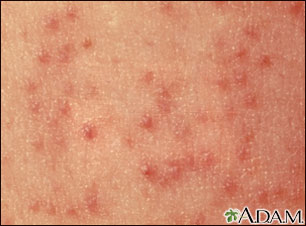
Keratosis Pilaris, a harmless condition in which your follicles get plugged up and irritated. What’s surprising is the how wide spread this problem. An estimated 40% of the population suffers from this affliction. Here’s the quick scoop from The American Osteopathic College of Dermatology:
“Keratosis pilaris is a skin condition commonly seen on the upper arms, buttocks and thighs. The skin cells that normally flake off as a fine dust from the skin form plugs in the hair follicles. These appear as small pimples that have a dry ‘’sandpaper” feeling. They are usually white but sometimes rather red. They usually don’t itch or hurt.
Keratosis pilaris is particularly common in teenagers on the upper arms. It may occur in babies where it tends to be most obvious on the cheeks. It may remain for years but generally gradually disappears usually before age 30. Keratosis pilaris is unsightly but completely harmless. It is usually worse during the winter months or other times of low humidity when skin dries out, and may worsen during pregnancy or after childbirth.”
The good news is this isn’t a serious problem and it can be treated to some extent. If you’re worried about it, go read this and this.
“Keratosis pilaris is a skin condition commonly seen on the upper arms, buttocks and thighs. The skin cells that normally flake off as a fine dust from the skin form plugs in the hair follicles. These appear as small pimples that have a dry ‘’sandpaper” feeling. They are usually white but sometimes rather red. They usually don’t itch or hurt.
Keratosis pilaris is particularly common in teenagers on the upper arms. It may occur in babies where it tends to be most obvious on the cheeks. It may remain for years but generally gradually disappears usually before age 30. Keratosis pilaris is unsightly but completely harmless. It is usually worse during the winter months or other times of low humidity when skin dries out, and may worsen during pregnancy or after childbirth.”
The good news is this isn’t a serious problem and it can be treated to some extent. If you’re worried about it, go read this and this.
Wednesday, March 7, 2007
what and who?
What Is Acne?
Acne is a disorder resulting from the action of hormones and other substances on the skin's oil glands (sebaceous glands) and hair follicles. These factors lead to plugged pores and outbreaks of lesions commonly called pimples or zits. Acne lesions usually occur on the face, neck, back, chest, and shoulders. Although acne is usually not a serious health threat, it can be a source of significant emotional distress. Severe acne can lead to permanent scarring.
Who Gets Acne?
People of all races and ages get acne. It is most common in adolescents and young adults. An estimated 80 percent of all people between the ages of 11 and 30 have acne outbreaks at some point. For most people, acne tends to go away by the time they reach their thirties; however, some people in their forties and fifties continue to have this skin problem.
Acne is a disorder resulting from the action of hormones and other substances on the skin's oil glands (sebaceous glands) and hair follicles. These factors lead to plugged pores and outbreaks of lesions commonly called pimples or zits. Acne lesions usually occur on the face, neck, back, chest, and shoulders. Although acne is usually not a serious health threat, it can be a source of significant emotional distress. Severe acne can lead to permanent scarring.
Who Gets Acne?
People of all races and ages get acne. It is most common in adolescents and young adults. An estimated 80 percent of all people between the ages of 11 and 30 have acne outbreaks at some point. For most people, acne tends to go away by the time they reach their thirties; however, some people in their forties and fifties continue to have this skin problem.
Tuesday, March 6, 2007
Acne Lesions

Troublesome acne lesions include the following:
Papules – inflamed lesions that usually appear as small, pink bumps on the skin and can be tender to the touch
Pustules (pimples) – papules topped by white or yellow pus-filled lesions that may be red at the base
Nodules – large, painful, solid lesions that are lodged deep within the skin
Cysts – deep, painful, pus-filled lesions that can cause scarring.
Papules – inflamed lesions that usually appear as small, pink bumps on the skin and can be tender to the touch
Pustules (pimples) – papules topped by white or yellow pus-filled lesions that may be red at the base
Nodules – large, painful, solid lesions that are lodged deep within the skin
Cysts – deep, painful, pus-filled lesions that can cause scarring.
Monday, March 5, 2007
Treatments for severe acne
Treatment for Moderate to Severe Inflammatory Acne
People with moderate to severe inflammatory acne may be treated with prescription topical or oral medicines, alone or in combination.
Prescription Topical Medicines
Several types of prescription topical medicines are used to treat acne. They include:
Antibiotics – help stop or slow the growth of bacteria and reduce inflammation
Vitamin A derivatives (retinoids) – unplug existing comedones (plural of comedo), allowing other topical medicines, such as antibiotics, to enter the follicles. Some may also help decrease the formation of comedones. These drugs contain an altered form of vitamin A. Some examples are tretinoin (Retin-A2), adapalene (Differin), and tazarotene (Tazorac)
Others – may destroy P. acnes and reduce oil production or help stop or slow the growth of bacteria and reduce inflammation. Some examples are prescription strength Benzoyl peroxide, sodium sulfacetamide/sulfur-containing products, or Azelaic acid (Azelex).
Like OTC topical medicines, prescription topical medicines come as creams, lotions, solutions, gels, or pads. Your doctor will consider your skin type when prescribing a product. Creams and lotions provide moisture and tend to be good choices for people with sensitive skin. If you have very oily skin or live in a hot, humid climate, you may prefer an alcohol-based gel or solution, which tends to dry the skin. Your doctor will tell you how to apply the medicine and how often to use it.
For some people, prescription topical medicines cause minor side effects, including stinging, burning, redness, peeling, scaling, or discoloration of the skin. With some medicines, such as tretinoin, these side effects usually decrease or go away after the medicine is used for a period of time. If side effects are severe or don't go away, notify your doctor.
As with OTC medicines, the benefits of prescription topical medicines are not immediate. Your skin may seem worse before it gets better. It may take from 4 to 8 weeks to notice improvement.
People with moderate to severe inflammatory acne may be treated with prescription topical or oral medicines, alone or in combination.
Prescription Topical Medicines
Several types of prescription topical medicines are used to treat acne. They include:
Antibiotics – help stop or slow the growth of bacteria and reduce inflammation
Vitamin A derivatives (retinoids) – unplug existing comedones (plural of comedo), allowing other topical medicines, such as antibiotics, to enter the follicles. Some may also help decrease the formation of comedones. These drugs contain an altered form of vitamin A. Some examples are tretinoin (Retin-A2), adapalene (Differin), and tazarotene (Tazorac)
Others – may destroy P. acnes and reduce oil production or help stop or slow the growth of bacteria and reduce inflammation. Some examples are prescription strength Benzoyl peroxide, sodium sulfacetamide/sulfur-containing products, or Azelaic acid (Azelex).
Like OTC topical medicines, prescription topical medicines come as creams, lotions, solutions, gels, or pads. Your doctor will consider your skin type when prescribing a product. Creams and lotions provide moisture and tend to be good choices for people with sensitive skin. If you have very oily skin or live in a hot, humid climate, you may prefer an alcohol-based gel or solution, which tends to dry the skin. Your doctor will tell you how to apply the medicine and how often to use it.
For some people, prescription topical medicines cause minor side effects, including stinging, burning, redness, peeling, scaling, or discoloration of the skin. With some medicines, such as tretinoin, these side effects usually decrease or go away after the medicine is used for a period of time. If side effects are severe or don't go away, notify your doctor.
As with OTC medicines, the benefits of prescription topical medicines are not immediate. Your skin may seem worse before it gets better. It may take from 4 to 8 weeks to notice improvement.
Saturday, March 3, 2007
How does acne develop?
Doctors describe acne as a disease of the pilosebaceous units (PSUs). Found over most of the body, PSUs consist of a sebaceous gland connected to a canal, called a follicle, that contains a fine hair (see "Normal Pilosebaceous Unit" diagram). These units are most numerous on the face, upper back, and chest. The sebaceous glands make an oily substance called sebum that normally empties onto the skin surface through the opening of the follicle, commonly called a pore. Cells called keratinocytes line the follicle.
Normal Pilosebaceous Unit
The hair, sebum, and keratinocytes that fill the narrow follicle may produce a plug, which is an early sign of acne. The plug prevents sebum from reaching the surface of the skin through a pore. The mixture of oil and cells allows bacteria Propionibacterium acnes (P. acnes) that normally live on the skin to grow in the plugged follicles. These bacteria produce chemicals and enzymes and attract white blood cells that cause inflammation. (Inflammation is a characteristic reaction of tissues to disease or injury and is marked by four signs: swelling, redness, heat, and pain.) When the wall of the plugged follicle breaks down, it spills everything into the nearby skin – sebum, shed skin cells, and bacteria – leading to lesions or pimples.
People with acne frequently have a variety of lesions, some of which are shown in the diagrams below. The basic acne lesion, called the comedo (KOM-e-do), is simply an enlarged and plugged hair follicle. If the plugged follicle, or comedo, stays beneath the skin, it is called a closed comedo and produces a white bump called a whitehead. A comedo that reaches the surface of the skin and opens up is called an open comedo or blackhead because it looks black on the skin's surface. This black discoloration is due to changes in sebum as it is exposed to air. It is not due to dirt. Both whiteheads and blackheads may stay in the skin for a long time.
Normal Pilosebaceous Unit
The hair, sebum, and keratinocytes that fill the narrow follicle may produce a plug, which is an early sign of acne. The plug prevents sebum from reaching the surface of the skin through a pore. The mixture of oil and cells allows bacteria Propionibacterium acnes (P. acnes) that normally live on the skin to grow in the plugged follicles. These bacteria produce chemicals and enzymes and attract white blood cells that cause inflammation. (Inflammation is a characteristic reaction of tissues to disease or injury and is marked by four signs: swelling, redness, heat, and pain.) When the wall of the plugged follicle breaks down, it spills everything into the nearby skin – sebum, shed skin cells, and bacteria – leading to lesions or pimples.
People with acne frequently have a variety of lesions, some of which are shown in the diagrams below. The basic acne lesion, called the comedo (KOM-e-do), is simply an enlarged and plugged hair follicle. If the plugged follicle, or comedo, stays beneath the skin, it is called a closed comedo and produces a white bump called a whitehead. A comedo that reaches the surface of the skin and opens up is called an open comedo or blackhead because it looks black on the skin's surface. This black discoloration is due to changes in sebum as it is exposed to air. It is not due to dirt. Both whiteheads and blackheads may stay in the skin for a long time.
Friday, March 2, 2007
life science & biotech intelligence, a global life sciences industry focused competitive intelligence firm, launched Skin Diseases Drug Development Weekly while the American Academy of Dermatology held its 65th annual meetingHiTIS added recently Skin Diseases Drug Development Weekly focused publication to its growing family of periodical competitive intelligence reports.Skin Diseases Drug Development Weekly is a weekly publication reporting industry and academy news in a digital format.
The reports cover the whole life cycle of drugs and diagnostics addressing those diseases, from lab-bench to patients, via regulatory process.Diseases covered include acne, bacterial skin infections, benign tumors, bullous diseases, cancers of the skin (basal cell carcinoma, melanoma…), dermatitis, fungal and parasitic skin infections, hypersensitivity and inflammatory disorders, hair and nail disorders, pigmentation disorders, psoriasis and scaling diseases, reactions to sunlight, sweating disorders and viral skin diseases…Collected news cover research, preclinical, clinical, regulatory, intellectual property, funding, collaborations, financial results (public companies) as well as M&A and legal issues.
The reports cover the whole life cycle of drugs and diagnostics addressing those diseases, from lab-bench to patients, via regulatory process.Diseases covered include acne, bacterial skin infections, benign tumors, bullous diseases, cancers of the skin (basal cell carcinoma, melanoma…), dermatitis, fungal and parasitic skin infections, hypersensitivity and inflammatory disorders, hair and nail disorders, pigmentation disorders, psoriasis and scaling diseases, reactions to sunlight, sweating disorders and viral skin diseases…Collected news cover research, preclinical, clinical, regulatory, intellectual property, funding, collaborations, financial results (public companies) as well as M&A and legal issues.
Thursday, March 1, 2007
A campaign to protect the skin of hairdressers is being launched by Huntingdonshire District Council Environmental Health Officers during December when they will be working closely with their Health and Safety Executive colleagues. Dermatitis is a potentially debilitating skin disease. The incidence amongst hairdressers is almost 20 times the national average for all workplaces because safety regulations are being ignored.
Up to 100 businesses will be visited to ensure that they are protecting the health of their staff by taking action against the risks of dermatitis.
Dermatitis can be contracted through ‘wet working’ and by handling chemical laden products such as peroxide or shampoo. It causes hairdressers’ skin to swell, redden, blister, flake or itch. The prevention of the disease can be achieved by the simple act of wearing protective gloves when washing customers’ hair and this helps to avoid a painful and unsightly skin disorder caused by constant exposure to water and chemicals.
Dr Susan Lammin, Head of Environmental & Community Health Services said, “It is very important to encourage good health and safety practices at work for hairdressers. Education is key as it’s important that hairdressers know how to protect themselves, what to look out for and what to do if they develop a skin problem.”
The visits coincide with a major campaign launched earlier this year by the British Safety Industry Federation and the Health and Safety Executive. The ‘It’s In Your Hands’ campaign is aimed at educating employers and workers towards better skin care in the workplace in order to prevent work-related dermatitis.
Up to 100 businesses will be visited to ensure that they are protecting the health of their staff by taking action against the risks of dermatitis.
Dermatitis can be contracted through ‘wet working’ and by handling chemical laden products such as peroxide or shampoo. It causes hairdressers’ skin to swell, redden, blister, flake or itch. The prevention of the disease can be achieved by the simple act of wearing protective gloves when washing customers’ hair and this helps to avoid a painful and unsightly skin disorder caused by constant exposure to water and chemicals.
Dr Susan Lammin, Head of Environmental & Community Health Services said, “It is very important to encourage good health and safety practices at work for hairdressers. Education is key as it’s important that hairdressers know how to protect themselves, what to look out for and what to do if they develop a skin problem.”
The visits coincide with a major campaign launched earlier this year by the British Safety Industry Federation and the Health and Safety Executive. The ‘It’s In Your Hands’ campaign is aimed at educating employers and workers towards better skin care in the workplace in order to prevent work-related dermatitis.
Subscribe to:
Comments (Atom)
